Building a company, and the system that runs it.
Vayrk is a revenue operating system for service businesses: HVAC, roofing, plumbing and other trades that sell by inquiry, estimate and appointment. I co-founded it with Jason Zipp, and I own its product architecture, rep systems, Website Factory and Revenue Engine.
- Role
- Co-founder
- Owned
- Product architecture, rep systems, AI
- Timeline
- Aug 2026 — Present
- Team
- 2 founders, 2 partners
- Stack
- Next.js · Supabase · Twilio · OpenAI
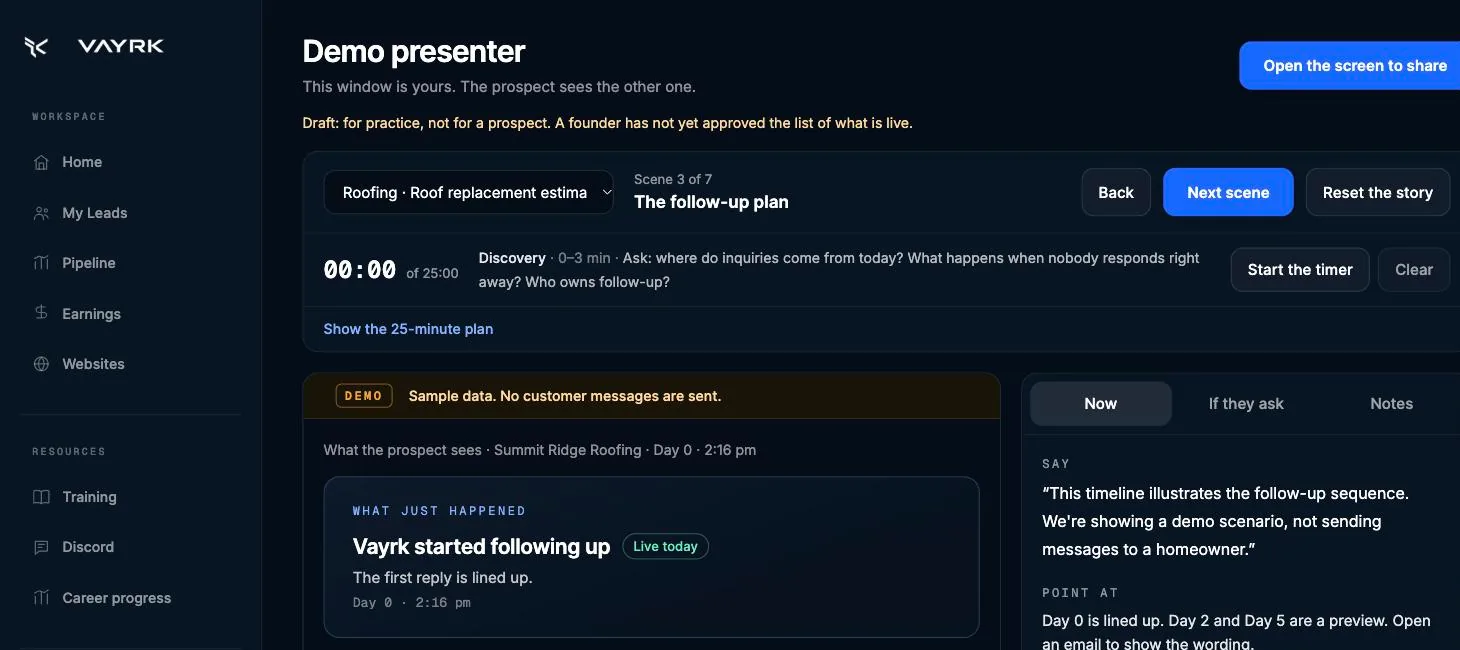
Service businesses lose work between an inquiry and the next step.
Vayrk is built for trades that sell by inquiry, estimate and appointment: HVAC, roofing, plumbing, electrical, landscaping and pest control. The first commit landed on 27 August 2026, under the working name Atlas Systems. Within five days it had a rep workspace, Twilio messaging, Stripe billing, the Vayrk name and the Sales Academy.
“…in the gap between an inquiry and the next step. Vayrk exists to close that gap.”
Where work was getting lost.
Each of the systems that followed answers one of these.
Reps needed one place to work a lead
Calling, outcomes, follow-ups, qualification and demos had to live on the lead itself.
Follow-up depends on someone remembering
Service businesses lose work between an inquiry and the next step.
Leads piled up with people who couldn’t call
1 Oct 2026: 404 of 410 leads never contacted. Four of the five sellers holding them had no call-forwarding phone.
The hardest part happens live, on the call
Reps needed help in the moment, not a script to read beforehand.
What I owned, and who I built it with.
- Product architecture and customer workflows
- Rep systems, the Sales Academy and lead sourcing
- Website Factory, the Revenue Engine and Vayrk Ops
- Live Sales Copilot v1, before handing it to Jason
- Vayrk Sales OS, the desktop app
- Founder decisions with Jason: pricing, launch, and who owns which code
- Selling: the two founders placed Vayrk’s first Production calls
- Jason Zipp — sign-in, billing, booking, releases, runtime reliability, and the Live Sales Copilot since 27 Sep 2026
- Nathan Cole — the Lead Intelligence crawler, the first Rep Training and the Discord bot
Of 667 merged pull requests to the Vayrk app (Aug–Oct 2026): 508 by Ayden, 154 by Jason, 5 by Nathan. Source: GitHub, 22 Oct 2026.
One workspace, five systems underneath.
Reps work in Home, My Leads, Pipeline, Earnings, Websites, Training and Career progress. Customer businesses get a CRM, Website Factory and Vayrk Ops.
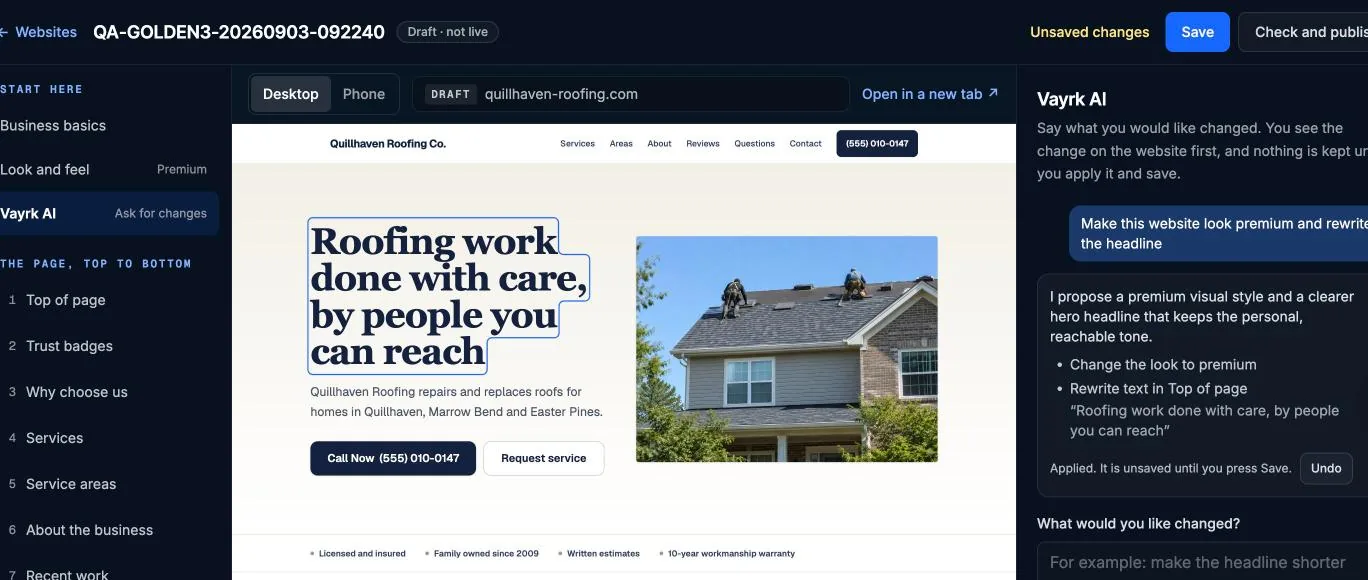
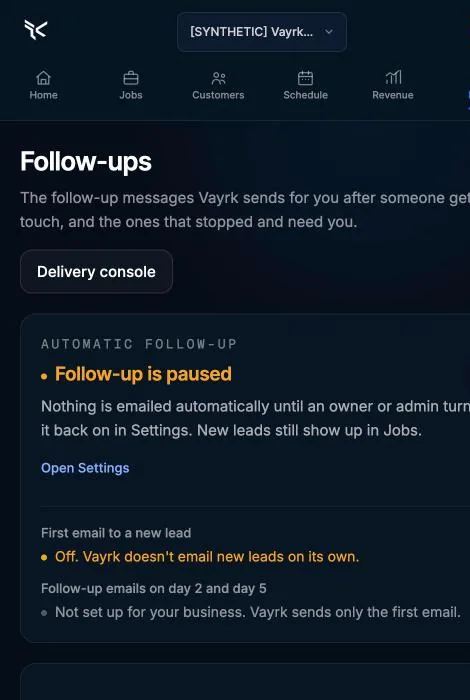
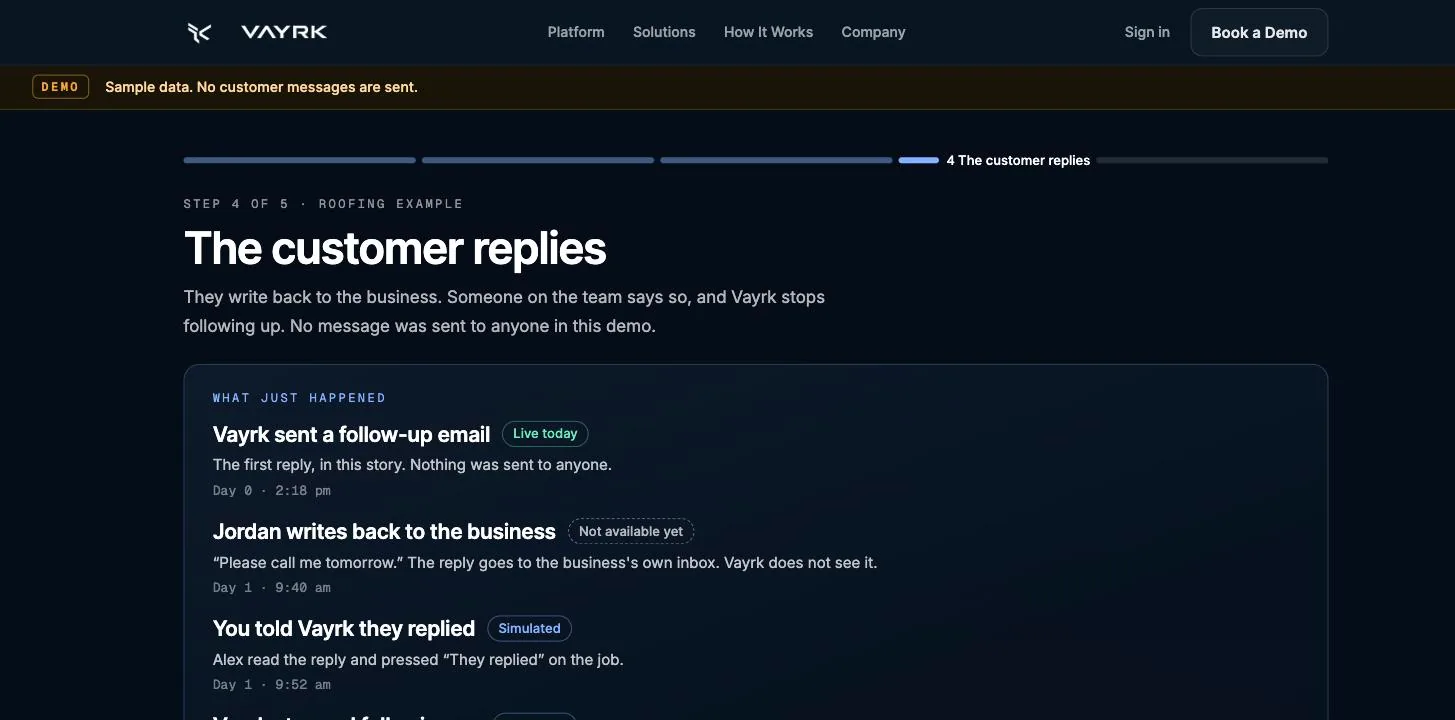
One set of routes. Rules in the database.
Data flows left to right. Every screen, the desktop app included, reads and writes through the same web app routes, so the business rules live in one place.
Rules stay in Postgres
New screens save through the routes the lead page already uses, so no client carries its own copy of the rules.
One price, enforced in code
Checkout refuses any amount except the approved launch offer, and reps have no discount authority.
Build vs buy
Calling on Twilio, billing on Stripe, email on Resend, sign-in and data on Supabase, models from OpenAI. The copilot gateway runs on Fly.io, because a long-lived audio connection can’t run on Vercel.
How it was built, in order.
- Phase 0127–31 Aug 2026
Foundation
First commit, under the working name Atlas Systems. In five days: the rep workspace, Twilio messaging webhooks, Stripe billing, the rebrand to Vayrk and the Sales Academy.
Shipped: Rep workspace · Stripe billing v1 · Sales Academy
- Phase 022–13 Sep 2026
Lead engines and Website Factory
Lead Intelligence and the Acquisition Engine, then Website Factory: sites built from a business’s own profile, with no AI in version one and no unverified claims in its templates.
Shipped: Acquisition Engine v1 · Website Factory · Google Workspace provisioning
- Phase 0314–21 Sep 2026
Live Sales Copilot
Designed and built in six phases in one week, then switched on in Production on 21 September. Handed to Jason on 27 September.
Shipped: Copilot v1: realtime gateway, sales brain, gates, replay harness
- Phase 0428 Sep – 19 Oct 2026
Platform and launch
New Homes for reps, customers and admins; an Integration Hub; leads dealt only to sellers who can call; an industry-neutral public site; a Founding Customer offer; and Vayrk Ops accepted on Production.
Shipped: Integration Hub · lead dealing · public site · Vayrk Ops
- Phase 058 Oct 2026
Vayrk Sales OS
A desktop app for reps: a secure window onto the rep portal, with the Sales Academy docked beside the lead being called. Built on Electron, chosen after building both an Electron and a Tauri prototype.
Shipped: Apple silicon Mac build (unsigned) · Windows installer built, not yet run
What changed, with receipts.
Every figure names its source and period. These are system results from development, Staging and Production records, not customer results.
| Measure | Before | After | Source · period |
|---|---|---|---|
| Leads held by sellers who couldn’t call | 304 of 410 | Dealing changed 1 Oct | ✓Production · 1 Oct 2026 |
| Copilot: end of turn → line on screen | — | 113 ms median | ✓Preview calls · 18 Sep 2026 |
| Vayrk Ops drafts sent without a person | — | 0 of 20 | ✓Staging run · Oct 2026 |
Vayrk Sales OS went from a two-engine spike to a packaged Mac app in one day, 8 October 2026.
Source: Sales OS MVP plan and commits · 8 Oct 202644 unit tests, 39 checks on the running app and 8 signed-out checks against vayrk.com. Not yet tested: Windows, signed installers, or a real call made through the app.
Source: Sales OS MVP plan and commits · 8 Oct 2026See it working.
A 60–90 second walkthrough of Vayrk, recorded on a demo workspace with sample data. The storyboard is ready; the video is not recorded yet.
- 01What Vayrk is0:00
- 02A request comes in, follow-up starts0:08
- 03The rep workspace0:22
- 04Sales Academy on the desktop0:37
- 05Website Studio0:45
- 06Vayrk Ops: drafts wait for a person0:58
Three calls I made building Vayrk Sales OS.
- Decision
- Host the web app instead of rebuilding it.
- Why
- Seven of the eight MVP items were screens the web app already shipped, so they arrive working and stay in step with the web. No change to sign-in, the database or anyone else’s code.
- Trade-off
- Day one adds only one new thing, the docked Playbook. With it open on a 1,024-pixel window, the portal gets 640 pixels.
- Decision
- Electron over Tauri, after building both.
- Why
- Electron runs the portal in Chromium on Mac and Windows, shares the hosted sign-in with no extra code, and keeps the browser capture tools the Copilot needs. First build: 13 seconds against 6 minutes 16.
- Trade-off
- A 123 MB Mac installer against about 10 MB, one Chromium per app, and a rule to update within two weeks of any Electron security release.
- Decision
- The Playbook is the Sales Academy, not new script text.
- Why
- The Academy is the approved script source, and founders edit it in one place. A second copy could drift, or promise something the product can’t deliver.
- Trade-off
- No stage-by-stage call scripts on day one. Those need an author, an approver and a place in the database.